Get 10% Veteran Discount Now
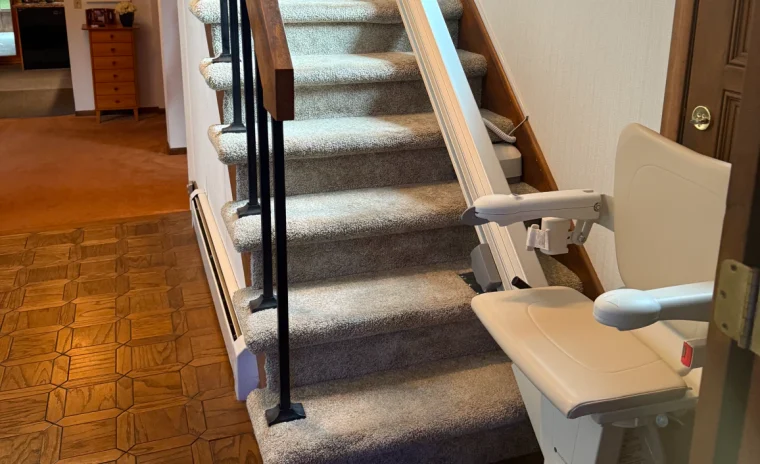
Installing a stairlift is not simply a matter of choosing a chair and fastening a rail to the stairs. A successful project matches the lift to the staircase, the rider, the transfer points and the way the surrounding hallway and landings are used.
This guide explains the difference between straight and curved stairlifts, what is measured during an assessment, how installation is planned and what homeowners should expect after the lift is tested and handed over.
Quick Answer: How Does Stairlift Installation Work?
A stairlift project normally follows five steps:
- Discuss the rider, staircase and access problem.
- Measure the stair flight, landings, clearances and potential conflicts.
- Select a suitable straight or curved system and the needed seat, rail and control options.
- Install and test the lift after the approved equipment is available.
- Review normal use, charging, parking and care with the customer or caregiver.
The details vary because a single straight flight, a staircase with turns and an outdoor stairway require different equipment and planning.
Is the Staircase Straight or Curved?
Straight Stairlifts
A straight stairlift is designed for one continuous flight without a bend, intermediate landing or change in direction. The rail is cut and configured for the measured flight. Straight systems can still require careful planning around a doorway, radiator, hallway, newel post, narrow landing or other feature at the top or bottom.
Mobility Solutions – R.C.I. offers supported Handicare straight stairlifts, including models selected according to the rider, staircase and environment. Options may include powered seat or footrest functions, a folding or moving rail solution, alternative seats or an outdoor package when available for the chosen model.
Curved Stairlifts
A curved stairlift is used when the route turns a corner, crosses an intermediate landing, follows pie-shaped steps or changes direction. Its rail is made to match the specific staircase and may include bends, parking sections or overruns.
The Handicare 4000 is one curved system we install. Product, seat and rail options are selected for the individual project, and availability can vary. Because the rail is staircase-specific, a curved project requires detailed measurement before it is ordered.
Read our Straight vs. Curved Stairlift Guide for a direct comparison.
What a Stairlift Assessment Covers
The Rider
The lift must fit the person as well as the stairs. The discussion may include:
- Ability to sit, stand and transfer at each landing
- Seat height, width and support needs
- Knee, hip or joint limitations
- Preferred control hand and ability to hold the travel control
- Use of a cane, walker or other mobility equipment at each level
- Whether a caregiver assists with transfers
- Suitable rated capacity for the selected model and configuration
A stairlift carries a seated rider. If a person must remain in a wheelchair or scooter between levels, a vertical platform lift or another access solution may be more appropriate.
The Staircase
Measurements and observations may include:
- Overall stair length, angle and tread layout
- Straight flights, turns, landings and winders
- Stair width and the space remaining for people who walk on the stairs
- Top and bottom landing size
- Doorways, halls and traffic paths near the rail
- Handrails, trim, radiators, windows and other obstructions
- Structure and condition of the stairs
- Available household power for the charging system
- Indoor or outdoor exposure
Getting On, Getting Off and Parking
The top landing deserves particular attention because the rider should be able to transfer in a stable position away from the open stairway. The seat, swivel function, rail ending and parking location are planned together. At the bottom, the rail should not create an avoidable conflict with a doorway or main walking route.
Depending on the model and staircase, a powered swivel, folding footrest, hinged rail, moving rail or extended parking position may be considered. Not every option is available on every lift.
Does a Stairlift Attach to the Wall?
Most residential stairlift rails are supported from the stair treads rather than fastened to the wall. The exact bracket layout and attachment method depend on the manufacturer, model and staircase. A site assessment identifies damaged, weak or unusual stairs that may require correction before installation.
Because the lift normally follows the stairs, extensive wall remodeling is not usually required for a straightforward installation. However, construction coordination may be useful when the landing, doorway, stair structure or surrounding route needs modification.
How the Stairlift Is Selected
Equipment selection should follow the assessment rather than the other way around. Important differences include:
- Straight, curved or outdoor configuration
- Rail length, side and parking position
- Seat dimensions and rated capacity
- Manual or powered seat swivel
- Manual or powered footrest
- Fold-up dimensions when the lift is parked
- Charger and charging-point arrangement
- Call/send controls
- Folding or moving rail options where a doorway or hall is affected
Mobility Solutions – R.C.I. defines the selected system and included options in the proposal. Product lead time and installation timing depend on the equipment, customization, site readiness and availability.
What Happens on Installation Day?
1. Confirm the Site and Components
The installer verifies the planned staircase, equipment and rail orientation before assembly. The work area should be clear, and another safe route between levels should be planned while the stairs are occupied by installation work.
2. Assemble and Secure the Rail
Rail sections and supports are assembled and positioned according to the selected system. The support points are secured to the stairs using the installation method specified for the equipment and site.
3. Install the Carriage, Seat and Controls
The carriage, chair, footrest, seat belt, controls and call/send devices are installed and adjusted within the product’s supported configuration.
4. Connect the Charging System
Many modern stairlifts operate from rechargeable batteries and use household power to maintain the charge. The charging arrangement varies by model. The installer confirms the accessible power connection and normal parking or charging positions.
5. Test Travel and Safety Functions
The technician tests operation through the full route, including normal controls, stopping positions, seat swivel, visible safety edges and other included functions. Any problem found during testing must be resolved before normal use.
6. Explain Normal Use
The customer or caregiver is shown how to enter and leave the seat, fasten the belt, operate the travel control, park the chair, use call/send controls and recognize normal charging indicators or warnings. The owner information for the selected model remains the primary guide.
How Long Does Stairlift Installation Take?
There is no universal installation time. A standard straight stairlift on a prepared staircase is different from a custom curved rail, an outdoor system or a project involving construction or electrical preparation. Product availability, customization, site access and conditions discovered during the work can affect the schedule.
The proposal should separate equipment lead time, site preparation and the planned installation sequence instead of promising one timetable for every home.
Will a Stairlift Work During a Power Outage?
Many current stairlifts use rechargeable batteries, allowing limited operation while sufficient charge remains. The number of trips depends on the system, battery condition, stair length, rider and other factors. A power outage also prevents the batteries from recharging, so the lift should not be treated as having unlimited backup operation.
Keep the charger connected and park the lift in its normal charging position as the model instructions require. If it begins beeping, moves slowly or will not charge, use our stairlift battery guide and beeping stairlift guide, then request stairlift repair if the cause is not resolved.
When Construction Coordination Helps
Some stairlift projects reveal a larger access issue. The work may involve a damaged tread, narrow landing, conflicting doorway, railing change, lighting concern or need for another mobility solution at the entrance. Mobility Solutions – R.C.I. is a division of R.C.I. General Contracting, LLC, allowing related construction work to be evaluated and coordinated when it is part of the approved scope.
Construction is not automatically required for every stairlift. The site assessment determines whether equipment installation alone is suitable.
Stairlift Installation in Sayre, Elmira, Ithaca, Binghamton and Mansfield
Mobility Solutions – R.C.I. provides scheduled stairlift assessments, sales and installation from Sayre, Pennsylvania throughout established service areas in Northeastern Pennsylvania and Southern Tier New York. Priority markets include Elmira, Ithaca and Binghamton, NY, and Mansfield, Montrose, Towanda and nearby Pennsylvania communities.
These are service areas rather than separate office locations. Our Sayre location at 225 Desmond Street is available by appointment.
After Installation: Charging, Care and Service
- Keep the charging system connected as the manufacturer instructs.
- Park the lift at a charging point or supported charging area.
- Keep loose objects, cords, clothing and pet items away from the rail and footrest.
- Do not lubricate the rail unless the manual for that model specifically instructs you to do so.
- Report new beeping, slow travel, hesitation, unusual sound or a change in stopping position.
- Arrange maintenance appropriate to the model, usage and written equipment information.
We provide stairlift repair and maintenance for supported equipment and can evaluate some lifts installed by another provider. Brand, model, condition and parts availability determine serviceability.
Request a Stairlift Assessment
Call Mobility Solutions – R.C.I. at (570) 980-2561 or contact us online. Tell us the project city, whether the stairs are straight or turn, whether the lift will be indoors or outdoors and anything that may affect transfers at the top or bottom.
Stairlift Installation FAQs
How do I know whether I need a straight or curved stairlift?
A single uninterrupted flight normally uses a straight rail. A staircase with a bend, intermediate landing, spiral, pie-shaped steps or change in direction generally needs a custom curved rail. An assessment confirms the route and any landing conflicts.
Can a stairlift be installed on either side of the stairs?
Often there is more than one possible rail side, but doorway clearance, landing space, traffic flow, handrails, power and transfer position affect the practical choice. The installer measures both the stairway and surrounding space.
Will the stairs still be usable by other people?
The amount of clear stair space depends on stair width, rail placement and the lift’s folded dimensions. Seats, armrests and footrests commonly fold when parked. The assessment considers other household members who will continue walking on the stairs.
Do you install outdoor stairlifts?
Outdoor models and packages are available for suitable straight or curved applications. Weather exposure, drainage, snow and ice, cover use, power and the selected product’s supported environment must be evaluated.
Can you replace an old stairlift?
Yes. We can evaluate the existing equipment, rail and staircase, discuss removal within the proposed scope and determine whether a supported replacement fits the current user and route. A curved rail made for one staircase normally is not transferable as a universal rail.
Do you provide repair after installation?
Yes. We provide service for equipment we support and review other stairlift repair requests case by case. Keep the model and serial number available when requesting service.